
ICE‑EV Gap Falls to 1.27%(August 28)
August Residual Value Trends: ICE-EV Gap Narrows to 1.27%, Market Landscape Reshaped — How Should Owners Decide?
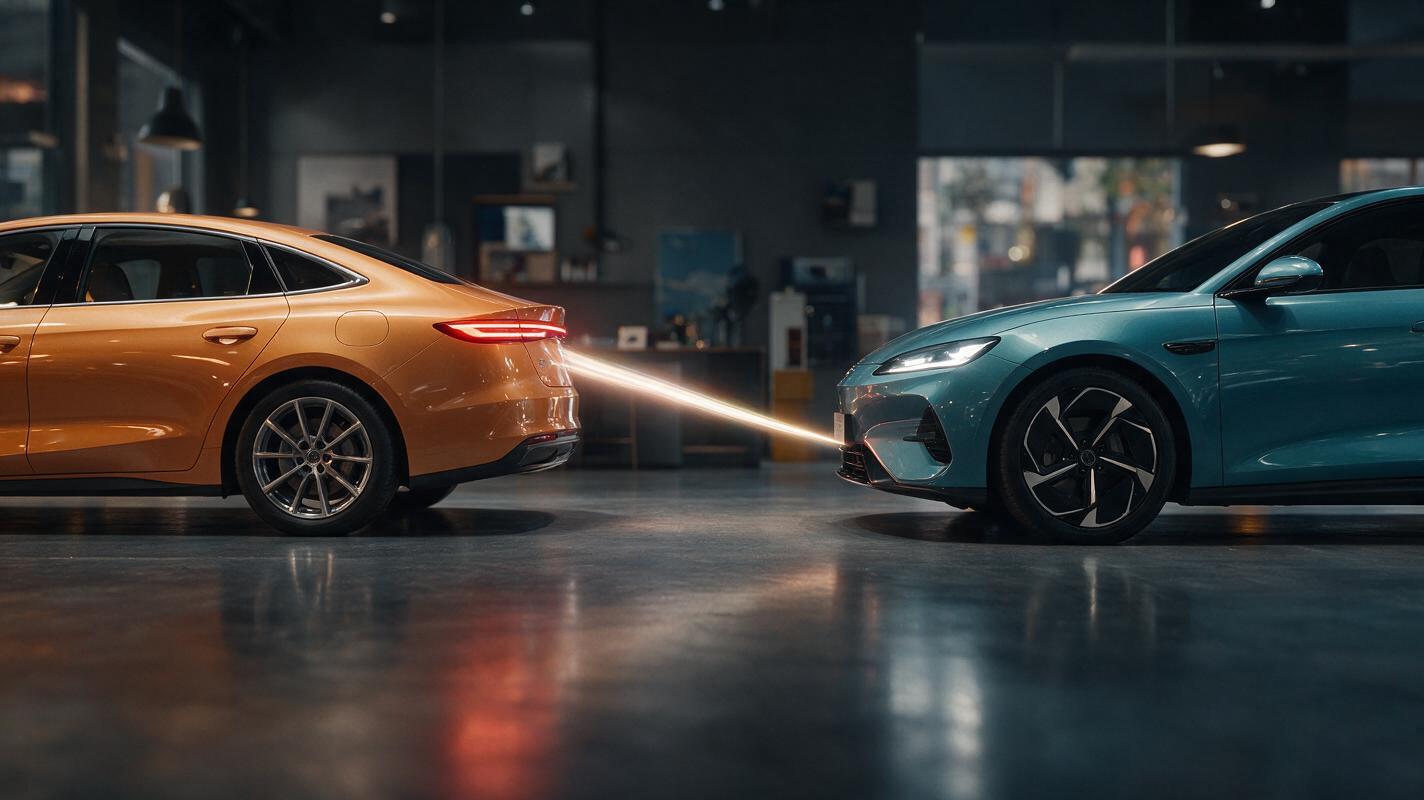
Just one month after the July residual value report, the Chinese automotive market is undergoing a deeper value restructuring. Internal combustion engine (ICE) vehicle residual values are accelerating toward a bottom, while the leading new energy vehicle (NEV) camp has demonstrated better-than-expected price anchoring capability. The residual value gap between the two camps is narrowing at an unprecedented pace.
According to data continuously tracked by the China Automobile Dealers Association and Jingzhengu, the three-year residual value rate for ICE vehicles has dropped from 67.6% in July 2022 to the current 46.07%, a cumulative decline of over 21 percentage points in four years. Over the same period, the three-year residual value rate for NEVs has risen to 44.8%, leaving the gap at just 1.27 percentage points — three years ago, this gap was approximately 13 percentage points.
This is a curve worth examining closely: from 13 percentage points to 1.27, ICE vehicles have traversed in four years a value decline channel that previously took two decades. Coupled with the fact that August NEV penetration in the new car market is approaching 50% (reaching 48.8%), the contraction of the future ICE vehicle fleet has become an irreversible trend. As the new car market scales toward balance, the value coordinate system of the used car market will inevitably be restructured accordingly.
In August, luxury ICE used car residuals experienced a cliff-like decline. Representative cases are striking: a 2022 BMW 530 Exclusive Edition saw its used car price drop from 250,000 yuan to just over 210,000 yuan within a single month, a depreciation of nearly 40,000 yuan; a Bentley Flying Spur with an original on-the-road price of approximately 5 million yuan is currently listed at only 268,000 yuan in the used car market, a staggering depreciation.
The July residual value report shows that the Xiaomi YU7 topped the pure electric segment with a one-year residual value of 82.8%, followed by Li Auto MEGA (79.7%), Zeekr 009 (75.4%), and Xiaomi SU7 (75.3%), forming the current "hard currency" matrix in the used car market. In the plug-in hybrid segment, the Tank 400 NEV ranked first among one-year-old plug-in hybrids with 78.0%, with the Tank brand performing notably overall.
Notably, a clear divergence has emerged between the pure electric and plug-in hybrid markets. On the pure electric side, leading brands are building used car price anchors through stable pricing strategies and product competitiveness, completely rewriting the old stereotype that "EVs don't hold their value." Meanwhile, older plug-in hybrid models are seeing accelerated value shrinkage due to the rapid iteration of "large battery, long range" technology, placing more significant pressure on their residual values.
Why is the ICE vehicle residual value retreating so rapidly? The core logic can be deconstructed from three dimensions:
First, the new car pricing system is loosening. From January to May 2026, 82 models implemented price reductions, with the average ICE price cut (14.6%) exceeding that of NEVs (12.5%) for the first time. The triple pressure of high inventory, escalating terminal discounts, and shifting consumer expectations toward "ICE prices will keep falling" has caused the ICE new car pricing system to lose its anchor, dragging used car prices down with it.
Second, a fundamental shift in consumer expectations. As NEV penetration approaches 50%, consumers' perception of "whether ICE vehicles are worth holding long-term" has undergone a structural change. In purchase decisions, residual value considerations are giving way to technology route judgments. The expectation that "ICE vehicles will eventually be replaced" is accelerating the depreciation of ICE used cars.
Third, the technology gap continues to widen. The rapid iteration of intelligent and electrified technologies means the experience gap between ICE vehicles and NEV products keeps growing. A three-year-old ICE flagship model may already lag behind current mainstream NEV products in smart cockpit features and driving assistance — this "experience depreciation" is being rapidly reflected in used car pricing.
The used car market is currently in a "shock bottom-building" phase, but bottom-building does not mean a rebound; it most likely means continued grinding at the bottom.
For ICE vehicle owners, the report judges that every additional month of waiting could result in a further 1%-2% depreciation. Taking a 200,000-yuan vehicle as an example, waiting three months could mean an additional loss of 6,000-12,000 yuan. This is not the time to "wait for a recovery"; rather, it is a window requiring rational decision-making.
For leading NEV owners, brands such as Xiaomi, Li Auto, and Zeekr have relatively firm used car prices and smooth circulation, but the window is equally limited — as new car technologies continue to iterate and new models are densely launched, the current "hard currency" status is not unshakable. It is advisable to sell at an opportune time before new model generations arrive.
The automotive residual value system is undergoing a thorough restructuring. From "ICE means value retention" to "ICE and EV parity," and potentially to "NEVs overtaking" in the future, the value coordinate system of the Chinese automotive market is being rewritten. For consumers, whether buying or selling, it is necessary to view the value changes of automobiles — a major consumer product — from a more dynamic and rational perspective. It is no longer an "asset" but a rapidly iterating "technology consumer product."
This platform focuses on the import and export of Chinese automotive equipment, gathering hundreds of certified Chinese automotive suppliers and connecting with global buyers. The platform achieves full transaction transparency, expands diverse cooperation opportunities, and helps both domestic and foreign parties build deep and stable cooperation bonds. Whether you are looking for vehicle manufacturers, purchasing automotive parts, or need customized procurement solutions, CNAUTO is your trusted first choice for cooperation.




